WAPUSH Interview with Joyce Antler
Madison Verner, Co-Director of the WAPUSH Oral History Project
July 2025
Madison Verner: Could you tell me what made you want to start uncovering hidden stories of Jewish women in America?
Joyce Antler: Certainly. When did I begin? Now I’m going to get hazy with dates. Jewish women were left out of the story that was beginning to be told on women’s history, of women’s history, which was itself a new field. I came into the academy late 70s, early 80s. There was very little about any women at all, and there was certainly nothing about Jewish women. For example, every couple of years there was a major conference that thousands of women attended, the Berkshire Conference of Women Historians. I don’t know if you know about that. It was usually someplace in New England, in the Berkshires, and really 2,000 to 3,000 people would come and hear wonderful papers and panels all about women’s history. The women had been left out. I remember one year, somebody called me and said, could you do something on Jewish women? They called me the day before or the week before the program had been set, and they said in
all these hundreds of sessions, there wasn’t one session, one paper that involved Jewish women. I quickly got together with a couple of people trying to get a fairly international perspective, as close as we can. That’s just sort of one indication of how the field was going. Jewish women were left out.
There was a conference at Wingspread, a conference center in Wisconsin for women who had been active in bringing women’s history to graduate programs of women’s history. It was a wonderful conference. Leaders of the field came from all across the country. Gerda Lerner was a great giant in women’s history, and she was there. I believe it was even in her honor, and it was astonishing to me that in these couple of days, again, there was nothing at all about Jewish women. The telling of the stories of Jewish women needed expression. and we needed to find out, were they different? Were they the same? Do they need their own kind of telling in different ways?
There was a third incident, and this was in the South. I remember, again, it was a major conference on women’s history. There were two graduate students who were part of a panel, and they spoke about Jewish women in the South, young graduate students. The commentator or chair of the panel, who was a distinguished women’s historian, one of the pioneers in the field, Ann Scott, no longer with us, commented in a very friendly way, but also critical. She said to these graduate students “the women that you spoke about were interesting, but why even bother to tell their stories? I mean, these Jewish women were just like other women. Do they deserve this attention of their own?” I was from Brandeis. I felt some responsibility, although we didn’t have a Jewish women’s program at the time. We didn’t even have a Jewish women’s
course. I got up and said from my seat, “this is an interesting question. We don’t know the answer.” Do Jewish women have a history that stands by itself? How does it fit into the larger history? I said, “let’s have a conference next year at Brandeis.” I was the head of the Women’s Studies program, so I could make such a statement. We did. We had a conference and it was the first one. I believe it was the early 1990s. We had people come and raise these questions. To take you back to a time when the enterprise of chronicling Jewish women’s stories was not at all organic, didn’t seem natural. Now I think, decades later, there are so many different themes, so many different kinds of stories to tell. I don’t think anybody would question whether this is a topic.
Verner: Extending from that, I think I saw that you were the founder of the Women’s Studies program at Brandeis. Is that correct?
Antler: Yes, more or less. There was somebody who was there for a couple of months, but, yes, I was the founder in about 1980.
Verner: Was that connected to your work with the Berkshire Conference or was that before then?
Antler: No, that was just connected to wanting to teach about women’s history. I was interested in this whole question of how women fit in. It was, at that time, a hard sell in the academy. There weren’t a whole lot of women’s studies programs all over the country. I remember we got together as women on the faculty. Again, there wasn’t a large number of them who were interested in their ideas. I remember some of the male faculty at that time saying, “what are you doing? Are you being separatists and sort of questioning why we were wanting to
gather? Was there, in fact, a topic?” We had a woman president of Brandeis at the time, Evelyn Handler, who was herself rather skeptical of a women’s studies approach. A lot of the things that I did early on, I did on my own without support from the university. The earliest women’s studies office was my office. We didn’t have any help or we didn’t have a room of our own. That changed over time. It took, you know, I’d say close to a decade. Wasn’t the easiest thing. This was happening around the country. It was certainly happening in the Boston area, and it worked. We formed a graduate consortium for women’s studies for six or seven. It grew to a larger number, maybe nine or ten. That started in 1992, I believe. I remember we took the president of Radcliffe College to dinner with the idea that we were going to seduce her into giving some money to support a project that we hadn’t started yet. She agreed! It was a small amount of money, enough to get together for a while. This was all just at the beginning. I think generations
forward, we forget that this was not the easiest thing in the world to put women into the academic scene.
Verner: I found that really cool. I was thinking that you’re literally forming a women’s history curriculum, just as my teachers are trying to do.
Antler: Yes. Yes. I was not in the history department. I was in American studies, which
was an interdisciplinary department. We didn’t have a graduate program. The history department didn’t have any women for quite a long time, longer than you would expect. It didn’t have any men who taught women’s history.
Verner: That’s really unfortunate.
Antler: Well, yeah, that’s true. It eventually became very strong all over our campus and other campuses as well. Yeah. These were the early years.
Verner: Yeah. I can imagine that that was a bit difficult. Okay, we’ll get into your books now. Can you tell me how you found the story of Lucy Sprague Mitchell, and why you
felt her story was an important one to tell in your book, Lucy Sprague Mitchell: The Making of a Modern Woman?
Antler: I came across the correspondence between Lucy Sprague and a man she fell in love with, Wesley Clare Mitchell, when I was doing dissertation research. This was as early as 1977. Something like that. I was looking at educated women in the progressive era, and she had been the first dean of women at the University of California. I came across, unexpectedly, love letters between her and this very distinguished economist who went on to start the Bureau of Economic Research. He was an esteemed professor at Columbia, and she was 33. They got married when she was 33. He was maybe five years older. As I said, she was the dean of women at the University of California at Berkeley. The love letters were all about if I wind up with you, I give up my independence. If you married at the time, you didn’t have an independent career. You didn’t have a life. You didn’t have anything. They were amazingly open and emotional. I got hooked by this correspondence. It became a chapter in my dissertation.
Then, I found, as we historians do, treasure troves of material, all unexpected. This is worth telling you these stories because it’s sort of a testament as to how you find information unexpectedly. At the Schlesinger Library for women here in Cambridge, there was a diary that Lucy’s aunt had left. I was looking at that information, but I didn’t know that she had left any materials. I then learned that her husband, this distinguished economist, kept a family diary every day of his life. As I said, Wesley Clare Mitchell founded the National Bureau of Statistics. He measured and kept track of everything. Everybody’s height, everybody’s height, their collar size, what they did in the morning, what they ate for lunch, all their hobbies. For a historian and for a historian of family life, this was amazing. I knew not only what he did, but what they did, what the family did.
However, the diary, this material of his, had been given to an economic historian who was writing a biography of Wesley, the husband of Lucy Clare Mitchell. He had them. They weren’t available to be seen. I had to go to this guy who was at Columbia and beg to have this material to see it. He said, “well, why shall I give it to you? I’m writing about Wesley.” He never published, by the way. He never published on Wesley Clare Mitchell. I said, “I’m not interested in that. I’m interested in the woman’s story and the family’s story.” He allowed me to look at the materials at the library with a librarian standing over me, and I finally was able to see that.
Then, I discovered hidden letters at the Bank Street College. I interviewed people in the family. There were many parts to doing this research. The initial impulse was this dilemma of marriage versus career, which for my generation of scholars and probably for yours as well, is still a big question. Here was somebody who took the plunge and documented it.
I might mention that I went up to interview her children in the late 70s. She adopted two children, and she had two natural children, so there were four children, three living and grandchildren and other members of the family. We went up in 1977, and we have gone back every summer. My family will be going there in a couple of weeks. I don’t own any property there, but Lucy wrote in her wonderful autobiography about Greensboro, Vermont. Greensboro was the centrifuge of our lives. It kept the generations together into three generations. Well, Greensboro has been the centrifuge of our lives. We’re into the third generation. My children, my
grandchildren, we have to go up there. This gets even more creepy. We rent the house that she built. We have for the last couple of years. I’m sleeping in the bedroom, in her bed, and on the bureau in front of me are the picture of her husband and her children that she put there. He died in 1948. It hasn’t been touched. Here I am as the biographer. I’m probably going to write about this a little bit this summer because it is unusual. People say, does the biographer loom over the subject and take over her life? This is like a step further, since I’m actually in her house. It’s a wonderful place. My kids and now grandkids really love it. That’s Lucy Sprague Mitchell.
Verner: That’s fascinating. You’re putting yourself in her shoes. You’re putting yourself in her bed, in her bedroom.
Antler: Well, yes, that really is true. The other thing that I will say is that because I am a historian and interviewed her children, I knew that her children didn’t like her, and she was not a role model for them. She was the anti-role model. They felt perhaps wrongly that she paid too much attention to the institution she founded, the Bank Street College. She was a role model for me in the sense of being a negative role model. I didn’t want that to happen with my daughters. I’m very attached to my institution, to the Women’s Studies program, and that figure was always in front of me. You have to find a balance so that they’re not going to despise you. That was not the only reason that they didn’t like her.
Verner: There’s other drama.
Antler: Yeah. Well, yeah.
Verner: That’s fascinating. Well, thank you so much for telling me about her. I would love to hear about the women you discussed in your book, Jewish Radical Feminism.
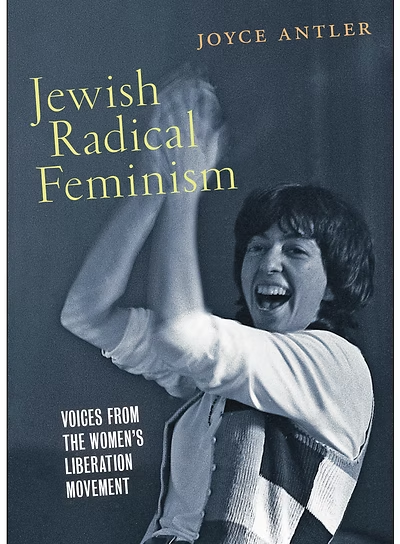
Antler: I’d be very happy to talk to you about them! It’s a group. Many of them I’m still in touch with. We have a regular Zoom call. We just spoke on Sunday. I’ll tell you about that. Five years after the book happened, we’re still meeting. I talk about 40 women. Twenty are Jewish women who were active in the Women’s Liberation Movement, but not as Jews, just in there, and they happened to be Jewish. The next 20 were involved in the Jewish women’s liberation movement, and they’re very aware of their Jewishness. I can tell you later why I chose them and how we got into this. What happened was there were two book parties after the book came out, one in Boston and one in New York. I invited people who were in the book to come. They met each other. Most of them did not know. Some of them knew each other, but certainly the people in the first part of the book who were secular radicals, women liberationists, did not know a lot of the Jewish feminists. Two of those women became good friends. Heather Booth, who’s in Washington. There’s a film made about Heather. She’s a progressive activist. She’s just a very important political figure and has been for the last 50 years. Heather met Lou Greenberg, who lives in Israel, who’s a Jewish feminist, who I consider radical. Maybe others would not consider her radical. She’s religious. Anyway, they became good friends, and we began this group. Some of the women in the book with other people that they knew began talking by Zoom once a month, and we’ve met a couple of times in person. We just met a couple of weeks ago, actually. Months ago, weeks ago. This has been going on for five years, and we talk about politics. We talk about our own lives. I think what we hold in common is that we identify as Jewish radical feminists. This is a little unusual. Usually, you have the women together and then you write the book. In this case, the book came first, and then it created this opportunity.
Verner: It’s almost like you created an identity through writing the book, reminding them that they are all in a Jewish, feminist community.
Antler: That’s right. I mean, they all have many communities and communities of feminists and communities in some cases of Jewish women. This is its own community, and we share intimacies, and we share politics. It’s just very special.
Verner: Could you tell me about the difference between the women’s liberation movement and how that’s separate from the Jewish radical feminist movement? How did they differentiate themselves?
Antler: I could give you many examples. The first group that I write about was a small group in Chicago who started the Chicago Women’s Liberation Union, which one might say was the first women’s liberation group in the country. There were four women who started it. One of them is Heather Booth, who I just mentioned, who’s now in Washington, Naomi Weisstein, Amy Kesselman, and Vivian Rothstein. These women came together and created significant social change in Chicago. They never considered themselves Jewish. They never understood that they were all Jewish, and that perhaps some of the values and some of the traditions that they had grown up with influenced them to become radical feminists. That was the story with those Red Stockings in New York, Our Bodies, Our Cells, the Health Book Collective in Boston, and several other groups that I worked with. They just happened to be Jewish, but they didn’t know it. The Women’s Health Book Collective that created Our Bodies, Our Cells. It turned out that nine of the original eleven were Jewish, and they never were aware of that. They never knew it until I came on the picture, for better or worse, because then they knew it. They had to figure out what was going on. Those numbers, it’s more than a coincidence. A third would be a coincidence, but three quarters means something. What about their early years, their formative years, their values might have led in this direction? That’s the question that interests me. It’s different in every case.
Verner: I assume they’re mostly Reformed Jews, right?
Antler: Well, the first half were Reformed Jews. There were conservative Jews. There were Orthodox Jews. Blue Greenberg and quite a number of others were religious Jews. I considered both.
Verner: How did Orthodoxy intersect with the radical feminism for the women who were part of Orthodox Judaism?
Antler: Oh, well, that’s a great question. There began to be, in the early 1980s, specific meetings, conferences, and associations of women who were Orthodox and who wanted a place where they could bring their feminism. Blue Greenberg, who was the leader in this and wrote a very formative book called Women in Judaism, was very much moved by feminist gatherings that she had been to. They really were her inspiration and made her think differently about subjects like abortion, about equal rights that she had never really thought about before. It certainly moved the needle for these women. Then, of course, they faced, you know, difficulties in bringing their feminist perspective to their communities, the communities they belonged to.
Verner: Yeah, I imagine it would impact you a lot because obviously it’s a very different perspective, but you can mesh it in some ways. I guess I can move on to what does your book, The Journey to Home, tell readers about the contributions of Jewish women in social movements in the United States?
Antler: Oh, right. That’s a good question. Even before radical feminism, and then by that, I mean the women’s liberation movement that started in 1968, there were many movements in which Jewish women played a major role, beginning in the late 19th century in the 1890s. Just to take one key event, the garment workers’ strike, 1909, which created the labor movement in the United States, was led by Clara Lemlich Shavelson. She married and she was a 17-year-old garment worker and gave the rallying cry in Yiddish. The fact that she was Jewish was really something.
I learned this is a funny story. I wonder how relevant it is. I was talking about the garment workers’ strike. I was giving a lecture many years ago in Florida, and I mentioned the garment workers’ strike, and my aunt was in the audience, and she said, “your grandmother was in the garment workers’ strike and was arrested and sent to prison.” I said, “Grandma?” I didn’t know. It was not something that was discussed. She was single at the time. This was 1909. Then, she married and had a family. While I knew she was forthright and a real balabusta, I didn’t know about her working class associations and backgrounds. The hidden history of Jewish women affects all of us, and it’s very powerful.
Verner: Could you give me more stories that are featured in The Journey Home that are related to the involvement of Jewish women?
Antler: I have it right here. We should talk about Emma Goldman, Rosa Pizzota, and Rosa Schneiderman. These are the anarchist radical women. Emma Goldman, who brought birth control into the world. That was major and very important.
Henrietta Zoll, Jesse Sampter, and Golda Meir were part of the Zionist movement. They conducted Zionism from a feminist perspective. Certainly on the same wavelength as general Zionism, but there was room for a women’s version. That’s really very important.
I look at some of the women in popular culture, Fanny Bryce, Edna Ferber, Gertrude Stein, and see them as Jews and how that influenced their lives in theater, in teaching, in the academy. I think Jewish women were really everywhere.
Then the two paradigmatic figures of Gertrude Berg and Ethel Rosenberg. I kind of put back to back Gertrude Berg, who was the Jewish mama par excellence in her TV series. Ethel Rosenberg, who was executed as a spy, had a lot in common. They grew up in similar backgrounds but went in different ways. What behavior was really necessary?
Then finally, I talk about the Jewish women’s formative role in the feminist movement, and that really begins in 1963 with Betty Friedan and the women in NOW, National Organization for Women. One of the women in the friendship group that I mentioned to you that’s been meeting now for five years is Muriel Fox. Muriel was one of the women who started NOW with Betty Friedan. She’s 98, and she was an early advertising executive. Very savvy. Remains savvy to this day. She’s written a book. I can find it for you. Ah! I can indeed because it’s right on my table. This is something to mention. (Shows a book) It’s called The Women’s Revolution: How We Changed Your Life. Muriel is 98. She co-founded the National Organization for Women, the NOW Legal Defense Fund, the Veterans Feminists of America, and so forth. She’s a very preeminent woman. The Jewish background is important to her. She’s part of this group.
Verner: That’s really, really cool. Also, it was probably so interesting to be able to interview all these amazing people who were so influential in the feminist movement.
Antler: Muriel I didn’t put in my book, but there were others I did. That’s always a regret. You can’t talk about everybody.
Verner: A little bit out of space. Okay. How does Talking Back: Images of Jewish Women in Modern America challenge the way most Americans think about Jewish women?
Antler: Well, the stereotype of Jewish women, the Jewish princess and the Jewish mother, are very powerful. They remain so to this day. There’s a new film out, which I just saw this weekend, called Bad Shabbos. I don’t even know if it’s playing where you are. Anyway, you know, it’s got one of these Jewish mother stereotypes. Kirish Sedgwick plays the negative Jewish mother in a more tolerable fashion than usual. The fact that this is how, you know, we usually associate Jewish women, particularly married Jewish women, as unpleasant, grasping, venal, manipulative, all of that. I just felt that’s not the way that they are, and we need to do something to change it. In Talking Back, and actually my other works as well, I wanted to give Jewish women the chance to talk back and show themselves as they really are, not in the stereotypical form. It is amazing to me that the power of that stereotype just continues. It’s easy. Our cultural producers seem to just rely on it.
Verner: Yeah. I think you had another book also on the Jewish mother, right?
Antler: Yes. You Never Call, You Never Write: A History of the Jewish Mother
Verner: I assume that’s also on the same topic of the stereotypes of Jewish mothers, right?
Antler: Yes, yes, yes. Of all the books I’ve written, that was particularly hard because it’s very difficult to deal with jokes. In the sense that when jokes last, there’s usually some nugget in it that it may not be true, but it’s hitting a chord. You never call, you never write. Well, is this something that Jewish women, Jewish mothers say? Is there something there to a sensibility of Jewish mothers? My daughter’s saying if I were writing it now, they’d say, “you never text. You never, you never call.” It’s an interesting question, you know, the power of the stereotype. It’s difficult to deal with stereotypes, to think about them.
Verner: Where does that stereotype come from?
Antler: I would say there was a change. The whole first part of my book is about the Yiddish mama as a powerful prototype in silent film, in Yiddish film, in Yiddish literature. Loving, benevolent, caring. An example of that in American culture early on was the character Molly Goldberg, played by Gertrude Berg on radio beginning in 1929, on television in the 40s and the 50s. She was a bottle buster. She talked a lot but was very loving and all of that. Marjorie Morningstar and Jenny Grossinger, a real person, fed the world in a fairly benevolent way. It turns sour, probably with the male writers of the 1950s, in particular Philip Roth. People of his ilk that portrayed the Jewish mother in terms of the nagging stereotype. Possessive, selfish, manipulative. Although, you can argue it was certainly more than that. Then, I argue that feminism does reconstruct the Jewish mother by making it possible to have Jewish mothers that are strong and powerful and yet play roles in their family.
Verner: Can you explain the specific meaning of the phrase, “you never call, you never write.”
Antler: It’s the mother saying to the kids to write more. I find myself doing it, too. I’ve got two daughters. I say, “I haven’t spoken to you today.” This constant need for communication. It’s a wonderful thing. I don’t know if it’s cultural. I think there are many different cultures that have the traits that Jewish daughters and Jewish mothers and Jewish sons have. There are many. We’re not the only ones. Yet it’s there. We should use what’s there and reflect on it. Fascinating.
Verner: Can you discuss how America and I: Short Stories by American Jewish Women Writers continues your mission of featuring the unspoken stories of American Jewish women?
Antler: That was fairly early on. Maybe that was 1990. I had been talking to a publisher about doing a book of short stories. At that time, I don’t know if it was an editor or somebody. Maybe it was the great writer, Cynthia Ozick, who was herself a great short story writer and novelist. Maybe she had said to me, “well, who are you going to put in this book there? There aren’t very many Jewish women writers.” I know somebody had said to me, “oh, that’s a book of three people” in terms of short story writers. Of course, I have in my book 25 or something like that. Then, there were all the people who were left out. In 1990, decades after the women’s movement began, to again fish out of this, our common culture, the contributions of Jewish women was, you know, it was a great challenge. It needed to be done to find that women’s
voice and the ways in which it specifically touched on Jewish life. Because, in fact, it did.
Verner: How did you decide who to feature then if you had to cut some people out?
Antler: Well, it’s organized according to the time period, early 19th century and then troubles in the new world around 1930 to 1960, and then another couple of periods. I think most people do get in. There were some people who did not, and I regret that. I remember I was talking about readings of the other book where people met, but I had readings of this book, too, and invited these authors. I remember we had one particular reading at Columbia University, and so these wonderful short story writers came. Quite a number of them didn’t know each other. They were not in circles where they met, and that was a wonderful thing. I remember them and how important it was to find this community. They’re wonderful writers.
Verner: It seems like a theme throughout your life that you keep writing a book or bring people together through your writings.
Antler: Oh, I have never thought about that, but, yes, that really is true. It’s a wonderful
thing. I mean that to connect people in books and to share our stories. I think it does have a lot to do with the women’s movement. It may not be true of people who write about other things, but the women’s movement is about perspective, solidarity. It’s been great.
Verner: It’s also very sweet that you can feature all these women. Also, if people told you, “oh, there’s only three people who could be featured in a book of Jewish women writers,” it’s really important for you to say “these other 22 that you haven’t heard of before.”
Antler: Totally. Totally. I do feel that way. Now, you know, we should say that Lilith Magazine was relevant, which started in 1976. It’s almost 50 years now. We need to focus on other ways in which Jewish women’s writings can come to the forefront and showcase the talents of these women. There’s not too much in Jewish women’s studies. There’s some.
Verner: Do you feel that there is a story from one of your books that needs to be incorporated in the AP U.S. Women’s History course?
Antler: Let me think about that. Cynthia Ollick’s The Shawl and Grace Paley’s Walking. These are three pages long. They are very powerful. There may be permissions issues. You can’t just take somebody else’s writing and put it in a curriculum. You’d have my permission. I have to think about that. I always in my own teaching have original documents.
Verner: Do you support the creation of an AP U.S. Women’s History course?
Antler: Oh, that’d be terrific. I think, yeah, because women’s history is fundamental, powerful, and gets left out. Women share a history with others, but it is also specific and determinative. There needs to be a place. Absolutely. It’s like the way I feel about “should there be women’s studies?” Yes. There should be women’s studies because that is the place where you focus on this subject. Women get left out or minimized.